Which mental health disorders impact refugees?
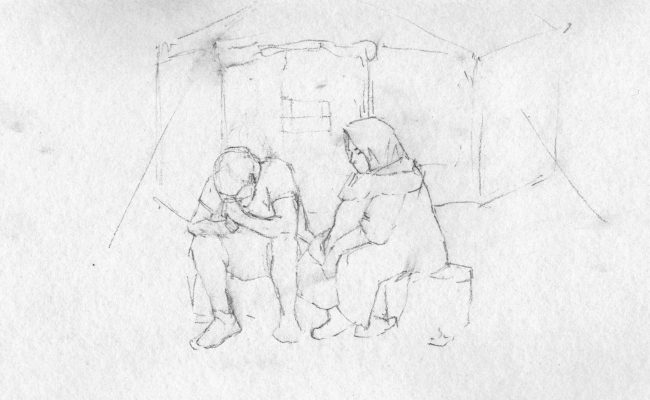
Obaidmother
Sketch by Elizabeth Thayer

Studies confirm that refugees are at substantially higher risk than the general population for a variety of specific psychiatric disorders. These disorders include:

  • PTSD
  • Major depression
  • Generalized anxiety
  • Panic attacks
  • Adjustment disorder
  • Somatization (Medical symptoms that have no known cause but can be linked to stress)
  • Chemical changes in the brain
  • Multigenerational trauma

Exposure to torture is the strongest predictor of symptoms of post-traumatic stress disorder among refugees.

(Kirmayer, L. J., Narasiah, L., Munoz, M., Rashid, M., Ryder, A. G., Guzder, J., Hassan, G., Rousseau, C., Pottie, K., & Canadian Collaboration for Immigrant and Refugee Health (CCIRH) (2011). Common mental health problems in immigrants and refugees: general approach in primary care. CMAJ : Canadian Medical Association journal = journal de l'Association medicale canadienne, 183(12), E959–E967. https://doi.org/10.1503/cmaj.0...)

Refugee voices on mental health

Rohingya Woman
Rohingya Women  ·  Myanmar

Humanitarian aid workers report on what they see in Hope Hospital in Cox's Bazar, Bangladesh:

What would you do if you had to leave everything behind?

By the end of 2025, more than 117.8 million people worldwide had been forcibly displaced by war, persecution, or human rights abuses — and 45 million of them are children.

They arrive in refugee camps and countries seeking safety and carrying little: legal papers, if they're lucky. A backpack. A child's hand in theirs.

What they carry that we can't see is heavier: fractured families, homes they'll never return to, professions they loved, friends and relatives they may never see again.

In a climate where immigrant stories are often ignored or twisted, we believe stories are a form of justice. When someone shares what they survived, they reclaim their voice. When we amplify it through film, photography, and advocacy, the world listens. Hearts soften. Policy begins to shift.

Because when a lawmaker sees a person instead of a statistic, and a neighbor understands instead of fears, rebuilding becomes possible.

Your support helps us share these stories where they matter most.

— Kristen Smith Dayley, Executive Director, Their Story is Our Story

Add Impact to Your Inbox
Sign up for our emails to get inspiring stories and updates delivered straight to you.
Subscribe
© 2026 Their Story is Our Story Privacy Policy
Their Story is Our Story is a 501(c)3 Non-Profit Organization under the United States Internal Revenue Code. All donations are tax-deductible. Our tax identification number is 812983626.