Education Changed My Life
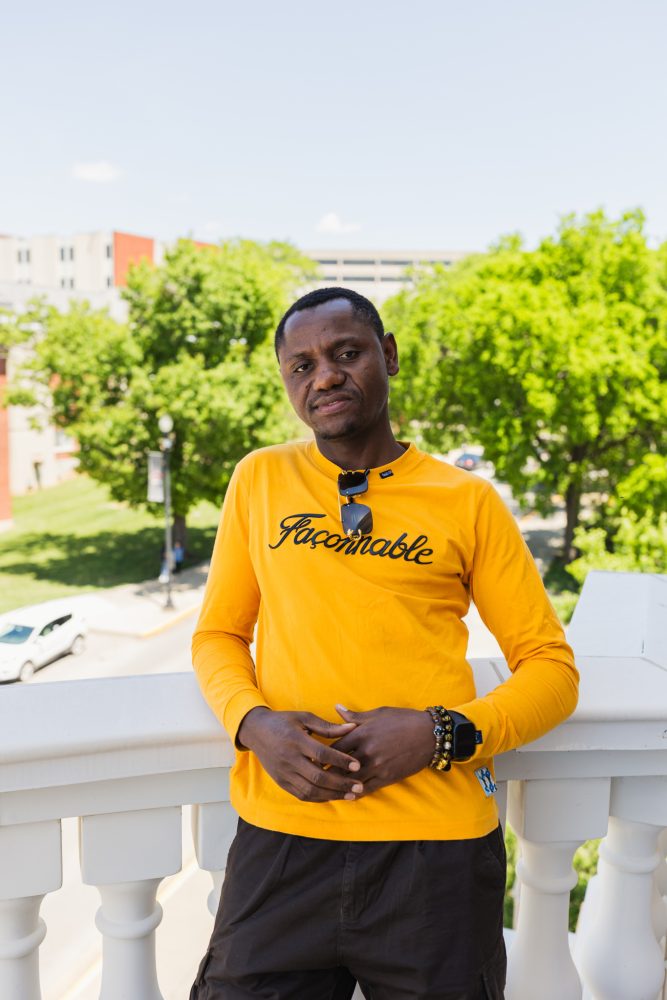
My name is Issa. This was my grandpa’s name, and also they gave my dad the name of my grandpa. Names in our African culture are transmitted from generation to generation. So the generations, they all have the same name. It’s an Arabic name that means “Jesus.”
I am from Fizi in the South Kivu province in the eastern part of the Congo. It is on the border of Lake Tanganyika. I don’t have a lot of memories because I left my country when I was five during what we call the Civil War of 1996.
We couldn't turn back home. We lost everything. We lost our homes. We lost our resources. We lost everything we could have in our country.
So it was hard to go back.
We took refuge in Tanzania in the Nyarugusu Camp. I lived there for almost 26 years. In the camp, we met a lot of people from different communities, from different beliefs, from different cultures. So that helped me to interact with people, respect people, and respect what they believe.
In 2017 we had the first interview with the resettlement officers from the UNHCR. And then we had the second interview with IRC, so the resettlement center support program from Kenya. And then, in August of 2022, we had the third interview with USCRI resettlement officer. And finally, on November 2, 2022, I came to the US and ended up in Bowling Green, Kentucky. So it took almost five years. Not all of my family came to the US together. I have 10 siblings, but here in the US it is only myself and 7 siblings. My mom is in Burundi with 2 of my siblings.
It was my first time living in a country where English is the major language, and also understanding cultural beliefs, customs, and food. It was like a new experience. But I’m thankful for the people of Bowling Green. They are welcoming people and they support you.
I was eager to learn. So I asked my case manager if I could attend school here. Back home I took some courses online and almost had a degree. I wanted to go farther with education–you know the USA is like the fifth country in the world, a superpower country. So if someone gets a degree from here it is supposed to be highly ranked around the world. So I asked, “What can I do?” On November 17, I went to a job fair and they told me to go to the admissions office at Western Kentucky University (WKU) and to learn more about the scholarships. So I came and I met with Amy at the admissions office, and she said they had scholarships available for refugees who are new arrivals. She told me I could apply and take a test to see how well I could learn in English: understanding, listening, and that process.
But it was hard. It was my first time trying to speak in English. I took Duolingo tests, and then I passed. They said I could learn and come to campus. Not knowing English makes it hard for many, many, many people, especially from Nyarugusu camp, because we speak Swahili. We learn in French and then just transition to the US speaking English–trying to get a job, trying to do an interview with a translator.
I’m studying a business and communications mix. And recently I received an approval for the JUMP program: Joint Undergraduate and Master’s Program. Hopefully I can get a master’s degree next year. It’s changed my life because now I’m able to apply for jobs that I want to. Not jobs that they want me to do. So it’s different, because now I can show what skills I have and I can attend interviews by myself without anyone. So I’m trying, even in my community, to tell people to go to school, especially the young ones.
Bowling Green is special for me because WKU is one of the only colleges in the USA that provides this scholarship to refugees. I don’t know if there is another one, but I think it is unique. They also have Chai Chat for students, so you can meet each other and help each other if we have something difficult to attend to.
I have some professors that help me. Dr. Lebedinsky, Dr. Zimmer, Dr. Biolsi, I can say they are mentors for me, because whenever I request something from them, they help me. And this is different from what I can say about other educational systems. Reaching professors in Africa–it was not easy.
My dream is to get a PHD here. And after that, to open some kind of small business and see if it can make it grow.
I want to open an African restaurant. We have so many people and they don’t have restaurants where we can find African foods, especially fufu. We need fufu.
I also want to connect people from the US to the Congo because we have large resources back in my country. But we need some people who can support us to maintain peace, and also to build our country to provide something for the development of my community. We had to go out of our country to find peace in another country. So why can’t we bring peace back to our country?
Our team members obtain informed consent from each individual before an interview takes place. Individuals dictate where their stories may be shared and what personal information they wish to keep private. In situations where the individual is at risk and/or wishes to remain anonymous, alias names are used and other identifying information is removed from interviews immediately after they are received by TSOS. We have also committed not to use refugee images or stories for fundraising purposes without explicit permission. Our top priority is to protect and honor the wishes of our interview subjects.
