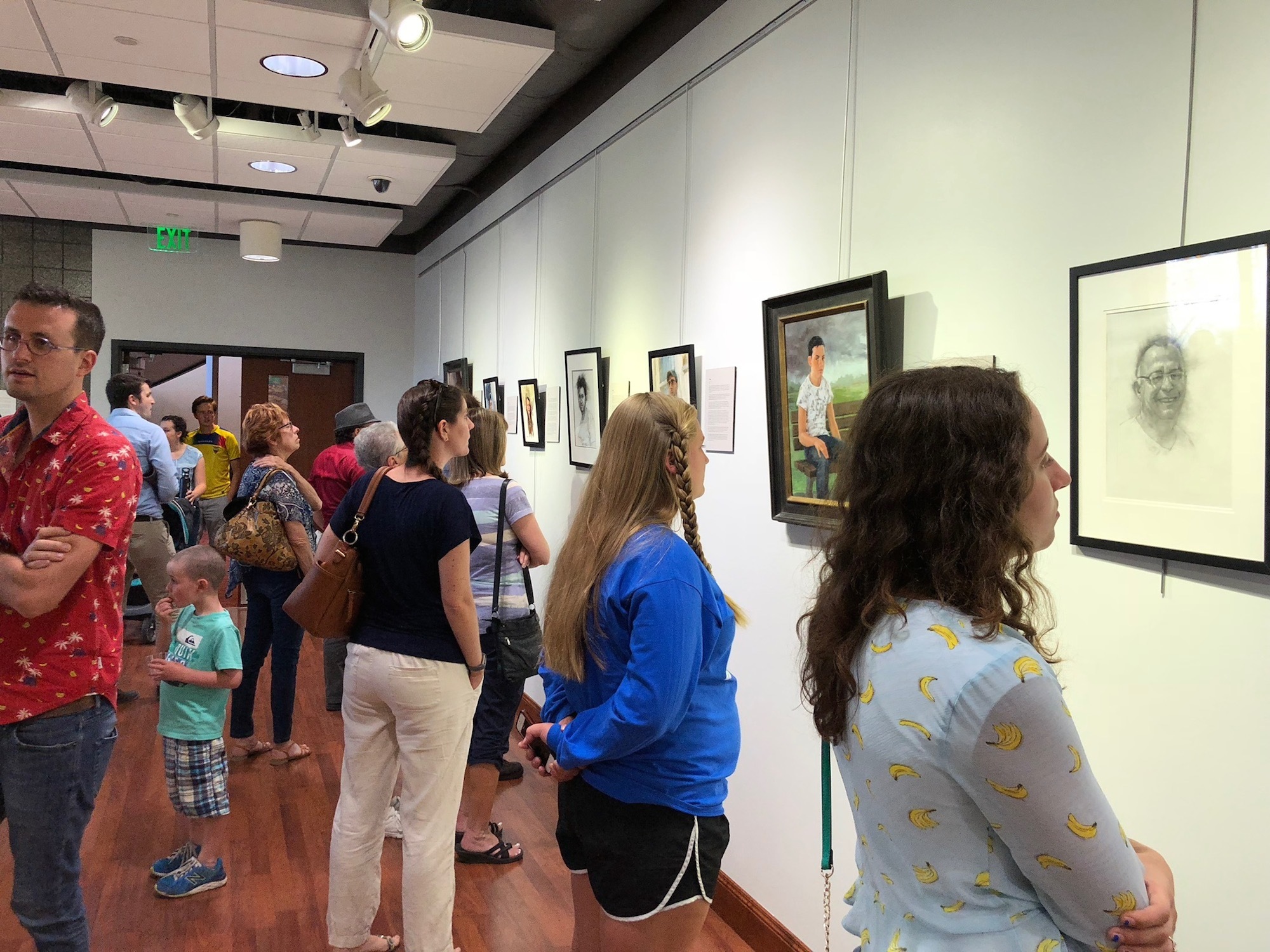
IN · HUMANITY Art Exhibit - NOW SHOWING
Written by Elizabeth Thayer
Go experience this incredible Art Exhibit in person!
July 6 - August 27
Covey Center Secure Gallery
425 W Center Street, Provo UT
10:00am - 6:00 pm
Artist reception
August 3, 2018, 6:00-9:00pm
To be human is to be one of many. I am one individual human; because I am human I understand the many.
All of humanity includes a very large number of individuals. The 7,500,000,000 people that live on the earth today are only a mere 7% of all humans to ever walk the earth. As individuals, we tend to categorize ourselves into smaller and smaller groups. It helps define us. I am female, I am Christian, I am Gen X, I am American, I am heterosexual, I am upper-middle class, and so on. Our categories make us feel understood, and safe. They create a comfort zone from which we judge the world. But they also insulate us from the larger reality of being part of the human race. When we categorize ourselves, we tend to categorize others. When a person becomes classified and labeled as a group, they are stripped
of their individual story. This dehumanization makes it easier to shun, insult, ignore, and injure.
Stories are the tools that can pierce the walls of classification. Stories remind us what it means to be human. We understand them because we are human. And telling them strengthens our humanity (singular and plural). A story can bring me out of my self-constructed walls into a dusty courtyard in the Middle East where a god-fearing mother has just lost her child and whose own life is threatened.
Because I have children of my own, I begin to understand her pain. Because I have feared for my children’s lives, I understand some of her fear. Because I have traveled into the foreign unknown, I understand her vulnerability. Now her actions make sense. Her gracious and generous nature has added significance. Real stories of real individuals are more powerful than statistics because they rely on shared experience and open the door for empathy.
When we look someone in the eye, it is harder to hate them. When we hear their story, we begin to understand. And understanding is the first step towards empathy and a better world. Empathy requires not just listening, but a setting aside of our own narrative. We let go of prejudices and preconceptions. We put on another’s shoes, enter their world, and feel as they feel. We begin to see eye to eye.
The more we hear, the more we understand. And when the story is heard, we step back into our own world that has now unexpectedly enlarged. Empathy inspires kindness, understanding, sacrifice, and compromise. Empathy can create bonds that reach through cultures, religions, borders, and generations, bonds that take humanity from the individual and biological meanings into the realm of collective and eternal.
These drawings and paintings represent an effort to bring you into another’s story. They are glimpses into the lives of refugees from the Middle East and Africa. They are only a few of millions who feel rejected, ignored, and forgotten. They want to tell their story. I want to show who they are. If you cannot stand literally face to face, I hope you will take this opportunity to look into their eyes and listen. Discover that their stories are actually all a part of our Story.
To be human is to be one of many. To show humanity is to take many and become one.
Helping ITPs Succeed: Insights from Leading Support Programs
Partner Profile: No One Left Behind
Their Story is Our Story and No One Left Behind (NOLB) joined forces in 2025 to launch the StoryShield program.
We spoke with Matthew Marcellus, Director of Communications with NOLB, and asked what the partnership with TSOS has meant for his organization and their Afghan clients.
Context with Layma
Social media presents us with an endless scroll of headlines and ‘hot takes’. What’s often missing is context. What is the history that led up to an event? Whose interests are served by a certain policy? What effects is that policy having on people’s lives? Layma Murtaza produces and hosts the video series “Context with Layma”, featured on Their Story is Our Story’s social media channels. We spoke to her about the context of her own life, as an Afghan-American and a professional in humanitarian aid, that led her to use storytelling to illuminate the personal and political context behind the headlines.